
By Dr. Margaret Onah
In many communities, HIV is still spoken about in whispers, if it is spoken about at all. Despite decades of global awareness campaigns, stigma and misinformation continue to shape how people understand the virus, how they respond to it, and unfortunately, how it continues to spread.
The truth is simple, yet often ignored: HIV does not spread because of malice. It spreads because of silence, delay, fear, and lack of awareness.
The Hidden Danger of Late Discovery
Consider a real-life type of situation that public health workers encounter far too often.
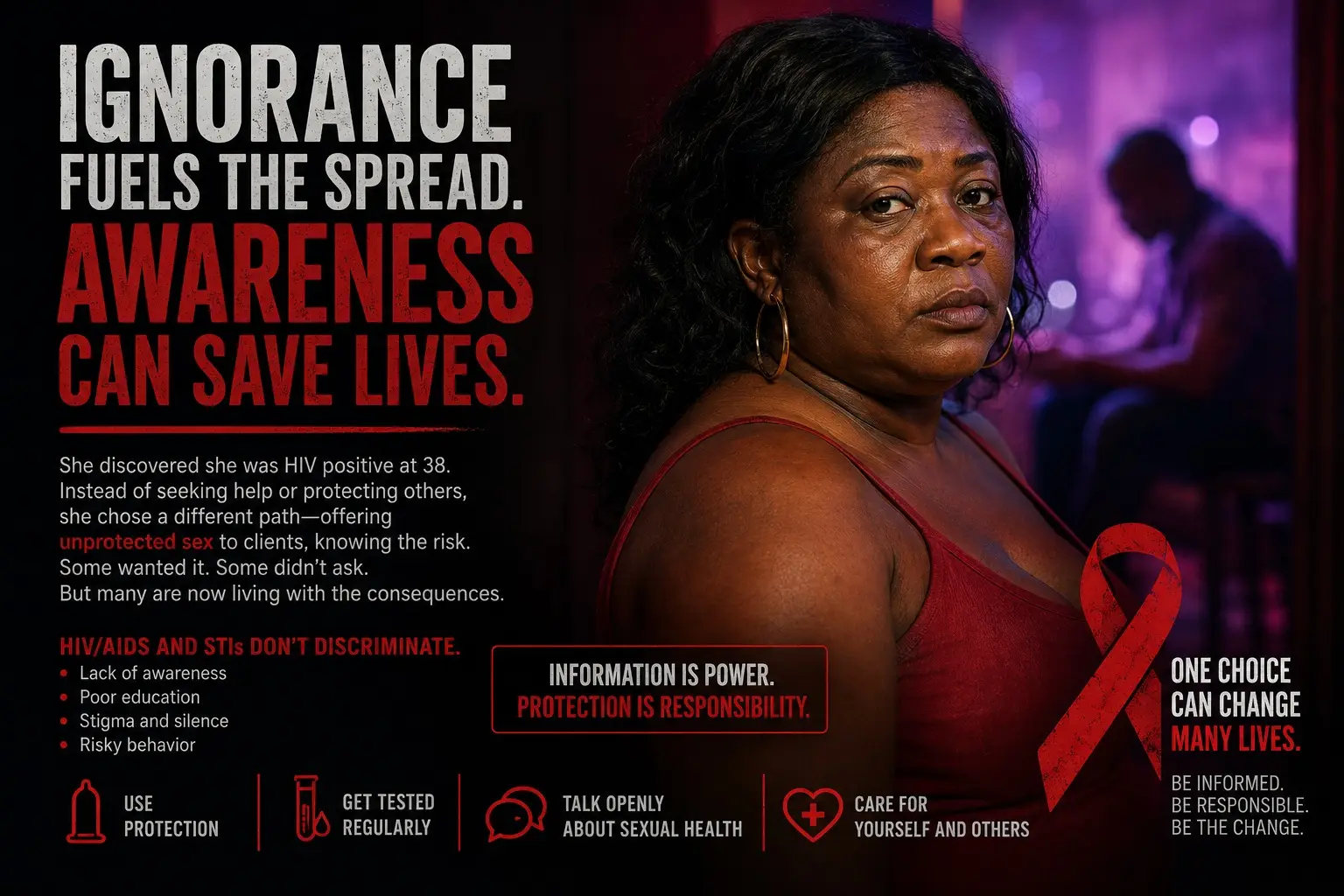
A woman in her late 40s, working in the informal sex trade, discovered her HIV-positive status at the age of 38 during a routine medical check. By then, she had already spent years unaware of her condition.
Like many others in similar circumstances, she was not immediately placed on consistent treatment, nor was she supported with proper counseling or structured care. Fear of stigma, economic survival, and emotional shock complicated everything.
Over time, she continued her work in environments where condom negotiation was inconsistent. Some clients insisted on unprotected sex, and in moments of financial pressure or vulnerability, protection was not always used.
This is not a story of intentional harm. It is a story of gaps—gaps in awareness, gaps in healthcare access, and gaps in protection systems.
And these gaps are where transmission continues.
The Real Engine Behind HIV Transmission
HIV spreads primarily through:
- Unprotected sexual contact
- Lack of regular testing
- Untreated sexually transmitted infections (which increase risk of transmission)
- Mother-to-child transmission without proper medical intervention
- Sharing of contaminated needles or sharp objects
But behind all of these biological pathways lies a deeper social issue: awareness is not evenly distributed, and access to healthcare is not universal.
Many people living with HIV do not know their status. Others know but are not yet on treatment. Some are on treatment but lack consistent adherence support. And many are trapped in environments where negotiating safe sex is difficult due to power imbalance, poverty, or coercion.
The Dangerous Role of Stigma and Misinformation
One of the most damaging forces in the fight against HIV is stigma.
When people fear being tested, they avoid knowing their status. When they fear discrimination, they avoid treatment. When they feel judged, they avoid disclosure—even to partners who may be at risk.
This creates a silent chain of transmission that is not driven by intention, but by avoidance and fear.
Misinformation also plays a major role. Myths such as “HIV is a death sentence,” or “you can tell who is infected by appearance,” continue to exist in some communities, leading to dangerous assumptions and risky behavior.
Sex Work, Vulnerability, and Reality
Sex workers are often unfairly blamed in discussions about sexually transmitted infections. In reality, they are among the most vulnerable groups when it comes to HIV exposure—not because of inherent risk alone, but because of structural conditions:
- Limited access to healthcare services
- Stigma from healthcare providers
- Client pressure for unprotected sex
- Legal and social marginalization
- Economic dependency
When prevention tools like condoms, testing services, and treatment are accessible and consistently used, transmission rates drop significantly—even in high-risk environments.
The issue is not identity. It is access.
Why Awareness Still Matters
Despite medical advances—especially antiretroviral therapy (ART), which allows people with HIV to live long, healthy lives and reduce transmission to near zero when taken correctly—awareness remains uneven.
Many people still do not know that:
- HIV is manageable with consistent treatment
- People on effective ART cannot sexually transmit the virus (U=U: Undetectable = Untransmittable)
- Regular testing is essential for early detection
- Condoms significantly reduce risk when used properly
Without this knowledge, fear fills the gap—and fear rarely leads to safer behavior.
Breaking the Chain
Stopping the spread of HIV and other STIs requires more than medical tools. It requires:
- Open conversations without shame
- Accessible and affordable testing
- Non-judgmental healthcare services
- Comprehensive sexual education
- Strong support systems for people living with HIV
- Economic empowerment for vulnerable populations
Because at its core, HIV is not just a medical issue. It is a social one.
Final Thoughts
The story of HIV is not one of villains and victims. It is a story of human behavior shaped by knowledge—or the lack of it.
Every delayed test, every avoided conversation, every untreated infection adds to a chain that can continue silently for years.
But the reverse is also true.
Every test taken, every condom used, every person educated, every stigma challenged—breaks that chain.
And that is where real control begins.